When a guest disembarks, the cabin is cleaned and prepared for the next arrival.
When an engineering fault is repaired, the maintenance task is closed.
When a positive bacterial result is remediated, many owners, captains, and crew naturally assume the problem has been solved.
Unfortunately, potable water systems do not always work that way.
On board a vessel, the water system often remembers.
Not because tanks, pipes, and fittings have a memory, but because biofilm, scale deposits, corrosion, sediment accumulation, low-flow areas, periods of stagnation, filters that are not replaced at the recommended intervals, inadequate maintenance of drinking water system components, and the failure to routinely verify sterilization or disinfectant residual levels through weekly testing can create conditions that allow microorganisms to persist long after a problem appears to have been resolved. This is why the same cabins, guest suites, crew areas, bars, showers, pantries, or sections of pipework frequently reappear on water testing reports year after year.
Understanding why this happens is one of the most important steps in establishing effective long-term water hygiene management on board.
The Hidden Environment Inside a Potable Water System
The inside of a vessel’s potable water system is very different from the clean, polished fixtures visible throughout the yacht.
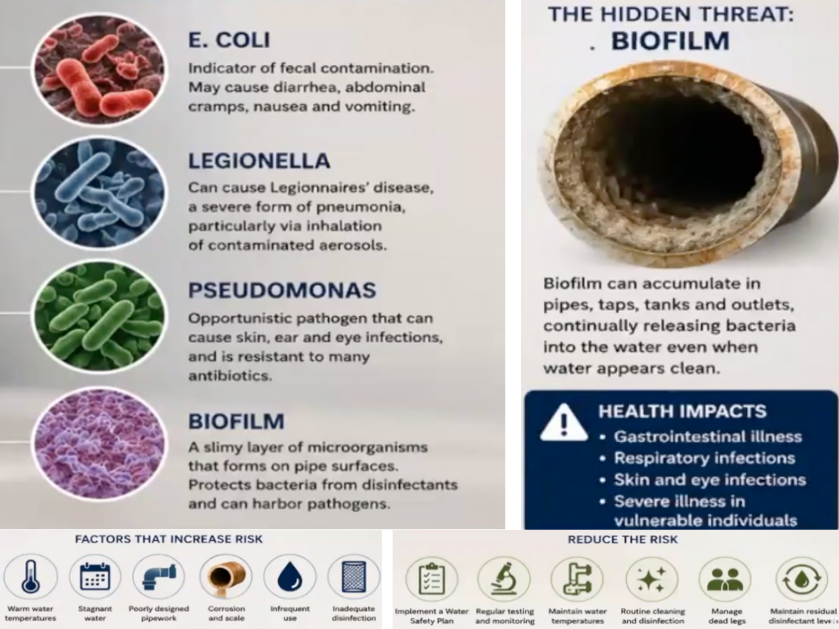
Over time, naturally occurring microorganisms attach themselves to internal pipe surfaces and begin producing a protective matrix known as biofilm. This biofilm can develop on virtually any surface in contact with water, including tanks, pipework, valves, flexible hoses, calorifiers, faucets, shower heads, and filtration equipment.
Once established, biofilm becomes significantly more difficult to remove than free-floating microorganisms suspended within the water itself.
Heterotrophic bacteria are often the first microorganisms to colonize internal water system surfaces and are among the most common building blocks of biofilm formation. As these bacteria accumulate, they create the foundation upon which more complex biofilm communities develop, providing an environment that allows other microorganisms to become established and persist. Legionella, Pseudomonas aeruginosa, and many other waterborne microorganisms are particularly well adapted to surviving within these biofilm communities. The biofilm provides protection from disinfectants, hydraulic flushing, temperature fluctuations, and other environmental stresses while simultaneously supplying nutrients that support continued growth.
As a result, a vessel may temporarily reduce bacterial levels through flushing, shock disinfection, tank cleaning, or other corrective actions, yet the underlying conditions that enabled microbial growth may remain unchanged.

Why the Same Outlets Continue to Reappear
One of the most common observations during yacht water management programs is the recurrence of issues in the same areas of the vessel.
A guest shower that tested positive two years ago may test positive again.
A seldom-used cabin sink may repeatedly exhibit low disinfectant residuals.
A sundeck bar or external shower may consistently return elevated bacterial counts.
A distant section of pipework may repeatedly experience temperature control problems.
These recurring findings are rarely coincidental.
Factors such as stagnation, low water turnover, inadequate disinfectant residuals, inconsistent onboard water testing for sterilization residual levels, poor temperature control, dead legs, oversized pipework, aging infrastructure, and infrequently used outlets can create persistent environmental niches where microorganisms continue to survive and recolonize.
The system appears to remember because the conditions that allowed the problem to develop have not fundamentally changed.
Temporary Improvement Versus Long-Term Control
Many vessels experience immediate improvements following remediation.
Positive samples disappear.
Residual disinfectant levels improve.
Bacterial counts decline.
The system appears healthy.
However, long-term success requires more than achieving acceptable test results for a few days, weeks or months.
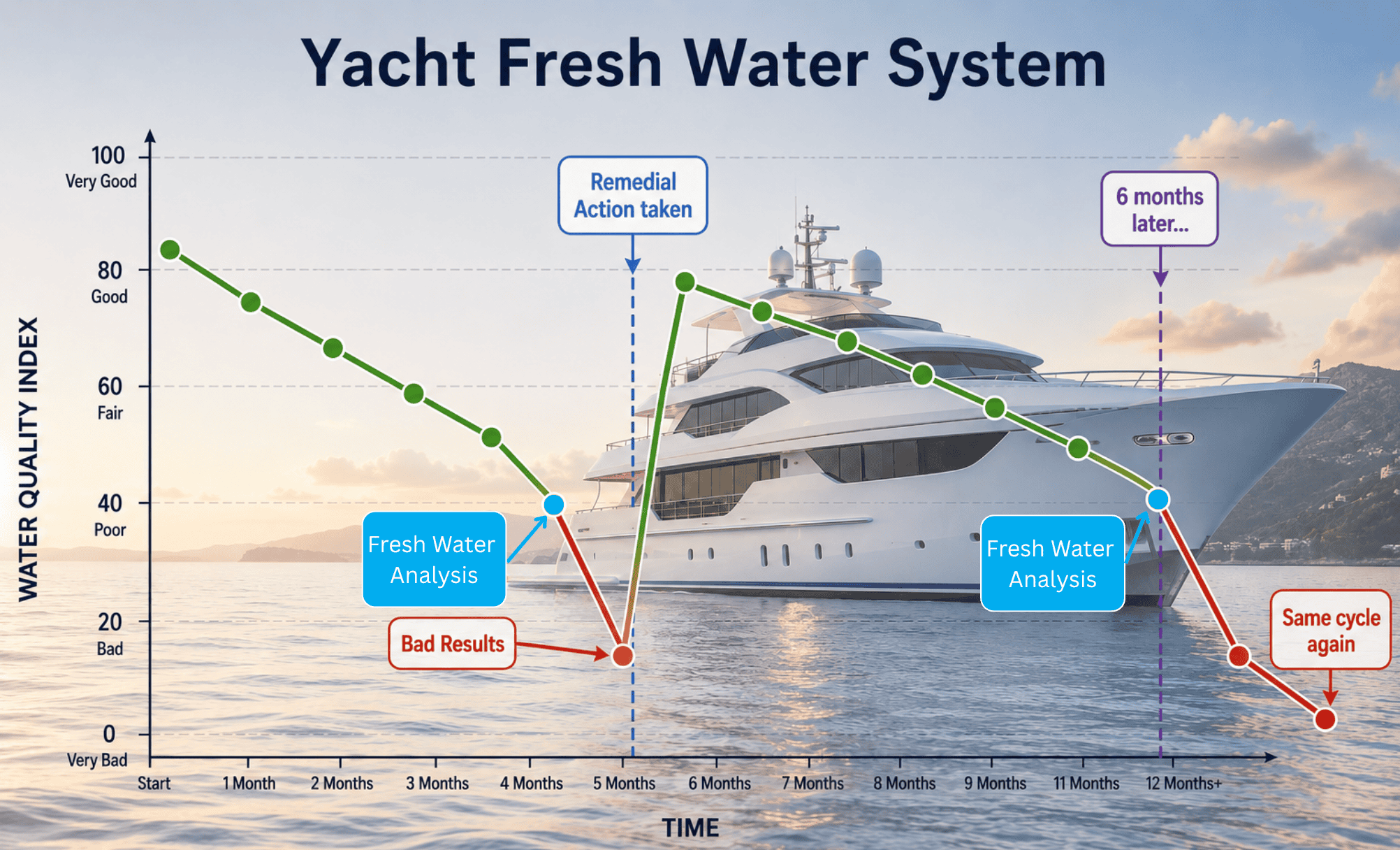
Biofilm-associated microorganisms can rapidly recolonize a distribution system when favorable conditions return. This helps explain why some vessels experience repeated positive findings months after a successful shock treatment or tank disinfection. The result is often a frustrating cycle: poor test results trigger corrective action, treatment produces acceptable results, confidence returns, and then the same issues gradually reappear. Bad results lead to treatment, treatment leads to good results, and good results are followed by bad results once again. Without addressing the underlying conditions within the system, this “yo-yo” effect can continue season after season, creating the illusion of progress while the root causes remain unchanged.
The objective should never be a temporary reduction in bacterial counts or simply obtaining a certificate of sanitation. The ultimate goal is to protect the health and wellbeing of everyone on board through sustained environmental control throughout the entire potable water system.
What Creates a Lasting Solution?
Vessels that achieve long-term success typically focus on controlling the conditions that support microbial growth rather than simply reacting to laboratory results.
This includes:
- Maintaining a consistent disinfectant residual throughout the distribution system, with routine monitoring and water testing used to verify that residual levels are being achieved and maintained.
- Monitoring water temperatures and understanding how elevated temperatures can increase disinfectant residual demand.
- Eliminating or managing dead legs and low-flow sections.
- Implementing structured flushing programs for low-use outlets.
- Identifying and managing guest and crew areas with infrequent occupancy.
- Monitoring trends in water quality over time.
- Verifying system performance through routine testing and inspection.
- Ensuring tanks, calorifiers, filters, and treatment equipment are properly maintained, including the routine replacement of filters in accordance with manufacturer recommendations and operational requirements.
- Applying appropriate sanitizing treatments to water softening equipment to maintain biological control and prevent microbial growth within resin beds and associated components.
- Carrying out periodic sterilization and disinfection of potable drinking water systems, tanks, and distribution networks where required.
- Maintaining accurate records and logs of water treatment activities, sterilization procedures, testing results, maintenance actions, and corrective measures to demonstrate ongoing control of the potable water system.
Most importantly, successful vessels recognize that water hygiene management is a continuous process rather than a one-time project.
The Value of Trend Analysis
Single or limited water samples provide little information.
Samples across a representative number of points provide information.
A trend provides understanding.
When water quality data is reviewed over months and years, patterns begin to emerge. Recurring problem areas become easier to identify. Infrastructure weaknesses become more apparent. Corrective actions can be targeted more effectively and resources can be directed where they are needed most.
The objective is not simply to achieve a satisfactory laboratory report before the next inspection.
The objective is to understand how the vessel’s potable water system behaves over time and to maintain control of the conditions that influence water quality.
Why Long-Term Water Management Matters
Potable water systems are dynamic environments, but they also have a remarkable ability to retain the conditions that allowed problems to develop in the first place.
Yachts and marine vessels present unique challenges because they often rely on a combination of onboard water production systems, such as reverse osmosis plants, and bunkered water sourced from multiple ports around the world. Each source can introduce different water quality characteristics, operational demands, and potential risks, creating a constantly changing environment that requires careful management.
Biofilm can persist.
Disinfectant residuals can fluctuate.
Infrastructure can age.
Water quality can vary depending on where and how water is sourced.
Low-use outlets can once again become vulnerable.
Owners, captains, engineers, and management companies who understand this concept often move beyond simply responding to positive test results and instead build sustainable water management programs that continuously reduce risk year after year.
Because in marine water management, success is not measured by what happens after the latest disinfection treatment.
It is measured by maintaining control despite changing water sources, varying operating conditions, and global itineraries—and by what does not happen during the next season, the next inspection, or the next year of operation.
Copyright® Octo Marine SAS – Author Dustin Wilson – June 2026
#watersafety #watertreatment #wateranalysis #marineengineers #captains #yachting